
SEMICONDUCTOR REVIEW THANK YOU FOR SUBSCRIBING
× 
Semi Conductor Review Weekly Brief
Be first to read the latest tech news, Industry Leader's Insights, and CIO interviews of medium and large enterprises exclusively from Semi Conductor Review
Semiconductor Review: Specials Magazine
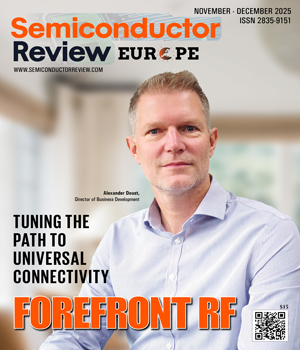
John is an avid globetrotter, ready for his next adventure. With a backpack and passport in hand, he straps a sleek cellular smartwatch to his wrist, hoping to stay connected wherever he goes. As he hops from city to city, the watch keeps him in touch until he crosses a border. In one region, it connects flawlessly, syncing messages, tracking health, and guiding him through unfamiliar streets. In the next, both it and his smartphone struggle to find a signal. The reason is outdated radio hardware. Behind the modern design, fixed-frequency filters and duplexers cannot keep up with today’s explosion of mobile communication bands, which have grown from just a handful in the 2G era to more than 40 across 4G and 5G networks worldwide. The devices’ cellular radios, once sufficient, now face an impossible balancing act: supporting more frequency bands without increasing size, cost, or complexity. Here, Forefront RF, a fabless semiconductor company, breaks the mold. Its tunable duplexer technology dynamically adapts to different frequency bands and cancels unwanted interference, replacing multiple static components with a single, flexible system. By simplifying the radio front-end, the solution reduces size and power consumption while enabling truly global connectivity. With support for more bands in a single design, device makers can eliminate regional variants, lowering production costs without sacrificing performance or efficiency. “We are reimagining the RF front-end design for smartphones, wearables, and IoT devices,” says Alexander Doust, Director of Business Development. “OEMs will be able to deliver products that automatically adjust to local communication bands worldwide, without the need for hardware modifications or additional components.” What began as a pure technology development effort has now evolved into a commercially viable solution. Forefront RF’s innovation is embodied in its multiband mobile radio front-end module, the FFM51010.
Photonics Solutions Provider in Europe
Manufacturers in the semiconductors, electronics and photovoltaics industries have long searched for customised laser-based equipment for their wafer fabrication and high throughput production needs. They find their ultimate solution in Photonics Systems Group, where precision meets innovation. The industrial machinery manufacturer develops, produces and sells high-volume, adaptive and cost-effective laser-based production solutions. The firm holds the combined power of three merged companies—InnoLas Solutions, specialising in drilling and cutting applications; L-TRIS Instruments, excelling in trimming applications and PROAUT Technologies, renowned for image processing and automation. Photonics Systems Group’s focus is not on creating distinct, custom-built machines for individual customers or one-off projects. Instead, it employs standardised, precise platforms optimised for mass production. Using these platforms, it develops production processes in collaboration with customers to suit their specific laser-based fabrication and manufacturing applications. It refines these processes in its application lab to produce automated machines, which are then replicated for deployment across multiple client facilities. “We adapt our machines to the production needs of customers whose processes require high throughput laser-based applications,” says Dr. Lutz Aschke, CEO. In the typical course of a project, clients engage Photonics Systems Group early in the conceptual stages while considering new laser-based processes. These processes can span the entire value chain, ranging from initial wafer treatments in early production phases to more intricate applications such as special doping processes, heat treatments, drilling holes and cutting substrates.

Optical Mems Solutions in Europe
weathered economic storms and growing pressure from low-cost markets, particularly in China, remaining a trusted name in fiber optic technology. A defining quality of Sercalo’s success is the reliability of its MEMS components and supply chain. “Reliability is not merely a selling point but an ongoing commitment that has cultivated long-term loyalty from many of our clients—some of whom have been partnering with Sercalo for nearly 20 years,” says CEO Cornel Marxer. Sercalo’s dedication to reliable supply and product quality sets it apart in a market where consistency is critical. Its optical MEMS switches stand out, especially models with up to 1x64 port configurations. The secret to their exceptional performance lies in Sercalo’s unique assembly process—laser welding—which enhances long-term stability, reduces thermal and wavelength dependency, and ensures durability over time. These features are crucial in applications where optical switches face varying environmental conditions, such as telecom networks or test systems handling multiple fibers.
CXO INSIGHTS

GaN market penetration in industrial electronics
Bas Reijnen, Principal Architect - Power Systems, Neways Electronics
How IP brings technological innovation to life
Kristof Beets, Vice President of Product Management, Imagination Technologies
The Pendulum in Our Industry Again Strikes Maximum
Philipp Molendo, Vice President Purchasing Electronics, BSH Home Appliances Group
Next-Generation AI Hardware
Dr. Nikolai Ardey, Executive Director VW Group Innovation, Volkswagen AG
Illuminating the Path to a Software-Defined Future
Matthaeus Artmann, Project Manager Advanced Systems & Technologies,, ZKW

Industry 4.0: Reimagining Manufacturing Operations
Thierry Wipff, Global Manufacturing Technology Engineering Tires, Continental

The Polarisation of Electrification
Magnus Bredin, Manager System Engineering, Micropower Group

IN FOCUS
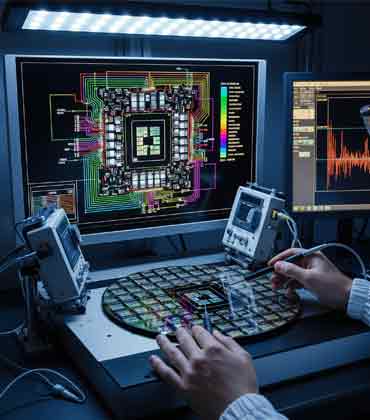
A Comprehensive Overview of Semiconductor Testing Practices in Europe
Testing is crucial at every stage of semiconductor development, from ensuring quality during chip fabrication to validating performance in advanced applications.
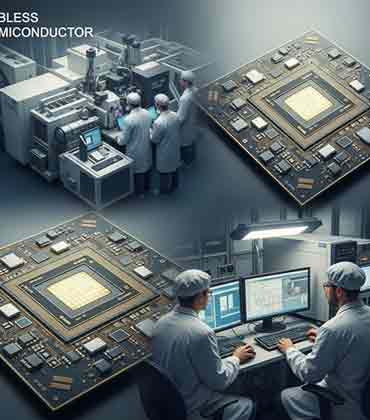
Europe's Rise as a Hub for Fabless Semiconductor Innovation
Europe's fabless semiconductor companies drive innovation in microelectronics, focusing on design, agility, and strategic partnerships for a resilient supply chain.
EDITORIAL
Europe’s Edge in Semiconductor Design
Europe is quietly becoming a hub for fabless semiconductors, a model that separates chip design from fabrication. By focusing solely on design, European firms can innovate faster, adapt to rapidly changing technological demands, and avoid the enormous capital expenditure of building their own fabs. This agility is crucial as industries increasingly require specialized chips for AI, automotive systems, and industrial applications. Fabless companies are leveraging Europe’s strong engineering talent, advanced research institutions, and collaborative ecosystems to produce designs that are efficient, scalable, and ready for the next generation of devices.
A key driver of this growth is the automotive sector, where AI is transforming vehicles from mere machines into intelligent systems. European fabless designers are creating chips capable of handling complex machine learning models with speed and energy efficiency. At the same time, electrification across the continent demands diverse solutions—from urban electric scooters to long-range heavy-duty vehicles—each with unique semiconductor requirements. The fabless approach allows designers to rapidly prototype and optimize chips for these varied applications without being tied to a single manufacturing process.
Industry leaders are making this transformation tangible. Dr. Nikolai Ardey, Executive Director of VW Group Innovation at Volkswagen AG, advocates for seamless integration between software and hardware, ensuring AI systems in vehicles operate efficiently and reliably. Meanwhile, Magnus Bredin, Manager of System Engineering at Micropower Group, emphasizes context-driven design, tailoring solutions to specific vehicle types, energy availability, and environmental conditions. Their work illustrates how design expertise and strategic foresight combine to shape Europe’s semiconductor landscape.
In this roundup, we spotlight European fabless semiconductors as a sector defined by agility, innovation, and precision. The challenge and opportunity lie in designing chips that not only meet today’s demands but also anticipate future technologies, ensuring Europe remains at the forefront of automotive and industrial innovation for years to come.
This content is copyright protected
However, if you would like to share the information in this article, you may use the link below:
https://www.semiconductorrevieweurope.com/edition/november-december-2025-29.html