
Thank you for Subscribing to Semiconductor Review Weekly Brief
× 
Semi Conductor Review Weekly Brief
Be first to read the latest tech news, Industry Leader's Insights, and CIO interviews of medium and large enterprises exclusively from Semi Conductor Review
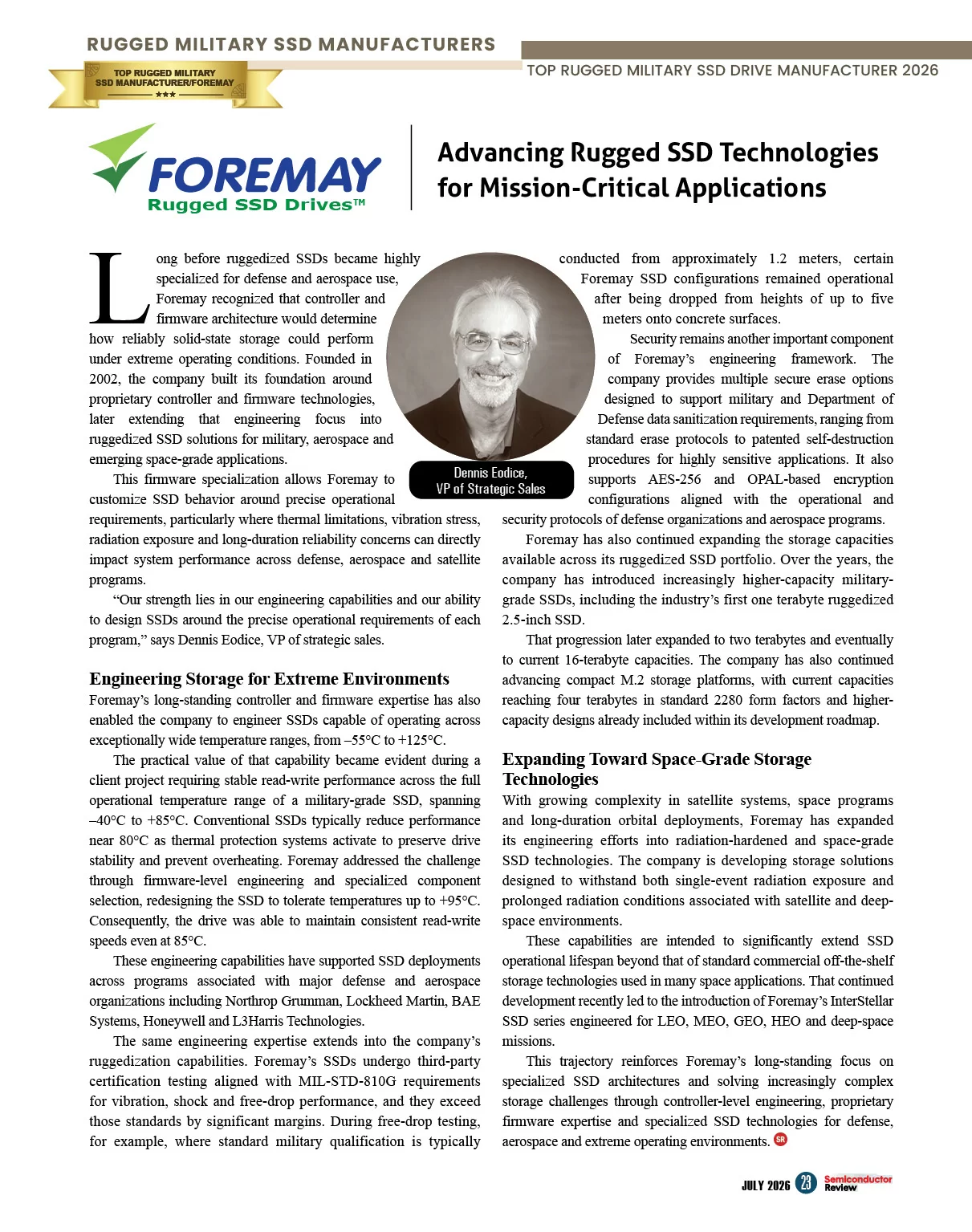
Foremay has been recognized by Semiconductor Review Magazine as the exclusive recipient of “Top Rugged Military SSD Drive Manufacturer 2026,” based on our proprietary methodology, reflecting its position in the industry, and is also named among “Top Semiconductor Manufacturing Services,” reflecting its broader leadership. This profile has been developed by the Semiconductor Review research and editorial team based on insights from an interview with Dennis Eodice, VP of Strategic Sales.



Foremay
Advancing Rugged SSD Technologies for Mission-Critical Applications

 Dennis Eodice, VP of Strategic Sales
This firmware specialization allows Foremay to customize SSD behavior around precise operational requirements, particularly where thermal limitations, vibration stress, radiation exposure and long-duration reliability concerns can directly impact system performance across defense, aerospace and satellite programs.
“Our strength lies in our engineering capabilities and our ability to design SSDs around the precise operational requirements of each program,” says Dennis Eodice, VP of strategic sales.
Engineering Storage for Extreme Environments
Foremay’s long-standing controller and firmware expertise has also enabled the company to engineer SSDs capable of operating across exceptionally wide temperature ranges, from –55°C to +125°C.
The practical value of that capability became evident during a client project requiring stable read-write performance across the full operational temperature range of a military-grade SSD, spanning –40°C to +85°C. Conventional SSDs typically reduce performance near 80°C as thermal protection systems activate to preserve drive stability and prevent overheating. Foremay addressed the challenge through firmware-level engineering and specialized component selection, redesigning the SSD to tolerate temperatures up to +95°C. Consequently, the drive was able to maintain consistent read-write speeds even at 85°C.
These engineering capabilities have supported SSD deployments across programs associated with major defense and aerospace organizations including Northrop Grumman, Lockheed Martin, BAE Systems, Honeywell and L3Harris Technologies.
The same engineering expertise extends into the company’s ruggedization capabilities. Foremay’s SSDs undergo third-party certification testing aligned with MIL-STD-810G requirements for vibration, shock and free-drop performance, and they exceed those standards by significant margins. During free-drop testing, for example, where standard military qualification is typically conducted from approximately 1.2 meters, certain Foremay SSD configurations remained operational after being dropped from heights of up to five meters onto concrete surfaces.
-
Our strength lies in our engineering capabilities and our ability to design SSDs around the precise operational requirements of each program.
Security remains another important component of Foremay’s engineering framework. The company provides multiple secure erase options designed to support military and Department of Defense data sanitization requirements, ranging from standard erase protocols to patented self-destruction procedures for highly sensitive applications. It also supports AES-256 and OPAL-based encryption configurations aligned with the operational and security protocols of defense organizations and aerospace programs.
Foremay has also continued expanding the storage capacities available across its ruggedized SSD portfolio. Over the years, the company has introduced increasingly higher-capacity military-grade SSDs, including the industry’s first one terabyte ruggedized 2.5-inch SSD.
That progression later expanded to two terabytes and eventually to current 16-terabyte capacities. The company has also continued advancing compact M.2 storage platforms, with current capacities reaching four terabytes in standard 2280 form factors and higher-capacity designs already included within its development roadmap.
Expanding Toward Space-Grade Storage Technologies
With growing complexity in satellite systems, space programs and long-duration orbital deployments, Foremay has expanded its engineering efforts into radiation-hardened and space-grade SSD technologies. The company is developing storage solutions designed to withstand both single-event radiation exposure and prolonged radiation conditions associated with satellite and deep-space environments.
These capabilities are intended to significantly extend SSD operational lifespan beyond that of standard commercial off-the-shelf storage technologies used in many space applications. That continued development recently led to the introduction of Foremay’s InterStellar SSD series engineered for LEO, MEO, GEO, HEO and deep-space missions.
This trajectory reinforces Foremay’s long-standing focus on specialized SSD architectures and solving increasingly complex storage challenges through controller-level engineering, proprietary firmware expertise and specialized SSD technologies for defense, aerospace and extreme operating environments.
Selecting Rugged Military SSD Drives for Defense Programs
Procurement mistakes in rugged military SSD drives rarely show up as a single failed part on a bench. They surface in qualification retests and program delays after storage has already been assigned to an avionics bay or mission computer. The device may be small; the penalty is not. For defense and aerospace executives, buying rugged storage is less a comparison of capacity and price than a judgment about the engineering control and configuration evidence needed behind a component expected to preserve data through vibration, heat exposure, cold starts and security-sensitive handling.
The harsher buying problem is the mismatch between catalog SSD assumptions and defense duty cycles. Commodity drives are judged around nominal environments and consumer refresh rhythms. A military program cares about thermal headroom at the envelope edge, predictable read/write behavior under load, shock records that can survive qualification review and a configuration freeze long enough for platform certification. In this context, the supplier’s command of firmware becomes more than a technical footnote. It determines whether a drive can be adapted to a program profile or offered as the nearest stock item.
Device fit is also a documentation problem. Test reports tied to MIL-STD-810G matter when vibration or drop requirements move from engineering notes into procurement files. Buyers should ask how a manufacturer handles controller changes and firmware revisions once a program moves from prototype to funded production.
NAND substitutions deserve the same scrutiny. An SSD that passes evaluation but returns six months later with a quiet architecture change can turn a straightforward replacement into another engineering review. Low unit cost loses meaning when the platform team must reopen test evidence.
Security deserves a narrower reading than the usual encryption checkbox. Defense users often need purge behavior that matches service-level instructions and post-event verification practices. A drive may need ordinary reuse, emergency purge, controlled self-destruction or write protection. Those behaviors depend less on packaging than on firmware authority and testable command paths. Executives should favor manufacturers that can discuss erase methods at the procedure level and explain how those methods interact with the controller rather than treating security as an accessory feature.
Capacity pressure is harder to separate from thermal and mechanical demands. Sensor volume, high-resolution capture, longer retention windows and unchanged space envelopes push density upward. M.2, U.2, 2.5-inch and VPX footprints create different tradeoffs around heat, service access, connector stress and lifecycle planning. Procurement teams should be skeptical of offers that treat higher terabytes as a simple scaling exercise. Density matters only when it remains compatible with temperature range, power-loss behavior, interface discipline and qualification evidence.
Foremay merits the premier-choice slot when firmware authority is a buying factor rather than a background detail. Its transcript record describes a manufacturer that began with controller and firmware work before expanding into full SSD production, giving it room to tune behavior for wide-temperature profiles and security commands.
Foremay’s site reinforces that scope, identifying rugged SSDs for defense, military, aerospace and space applications and the SC199 line for mission-critical rugged computing. It also lists SSD technologies that include secure erase, hardware encryption, write-protect functions and power-down protection. For executives weighing qualification risk against storage density, Foremay is a disciplined recommendation for rugged military SSD procurement.
...Read more
Vendor Viewpoints
Industrial Direct Part Marking: How Process Selection Impacts Overall Production
Viola Kirk, Campaign Manager

Rugged Military SSD Drive Manufacturers Info
Q1
What Do Rugged Military SSD Drive Manufacturers Provide For Mission-Critical Systems?
Rugged Military SSD Drive Manufacturers design storage for environments where vibration, shock, heat, cold, power events and data exposure can interrupt operations. Unlike ordinary commercial drives, these products are built around controlled endurance, secure data handling and predictable operation across harsh deployment conditions. The category covers military-grade SSD, space-grade SSD and embedded flash storage used when failure tolerance is low. It also reflects the need for storage that can be specified, qualified and supported as part of a larger electronics platform, rather than treated as a commodity part.
Q2
How Does Foremay Support This Category Through Its SSD Work?
Foremay shows how Rugged Military SSD Drive Manufacturers combine device engineering with application-specific durability. Founded in Silicon Valley in 2002 and headquartered in Pasadena, California, it designs and manufactures rugged SSD products for defense, military and space use. Its portfolio includes radiation-hardened SSD drives, wide-temperature options, anti-shock and anti-vibration construction, hermetically sealed designs, secure erase, self-encryption and self-destruction capabilities. That breadth helps connect storage reliability with the physical, thermal and security demands of fielded systems.
Q3
Which Capabilities Matter Most In Rugged SSD Storage?
The most important capabilities include environmental tolerance, interface flexibility, data protection and long-term reliability. Rugged Military SSD Drive Manufacturers often support SATA, NVMe, M.2, U.2, PCIe, VPX, CompactFlash or embedded formats so storage can fit existing systems. Evaluation also includes operating-temperature ranges, vibration resistance, encryption, write protection and purge functions because storage must remain dependable when systems move between field, vehicle, airborne or space environments. Capacity and speed still matter, but they are strongest when paired with durability and controlled failure behavior.
Q4
Why Is Security Central To Military-Grade Storage?
Security matters because the drive may hold sensitive mission, system or operational data. Rugged Military SSD Drive Manufacturers address this through hardware encryption, self-encrypting drive features, crypto erase, secure erase and controlled destruction options. These functions help reduce the risk of recoverable data after loss, capture, retirement or emergency shutdown, while still preserving storage performance during normal operation. In practical terms, security is not an accessory to rugged storage; it is part of the drive architecture.
Q5
Where Does Foremay’s Product Range Fit In Harsh-Environment Computing?
Foremay fits the category by offering standard and customized SSD options across multiple form factors, including 2.5-inch SATA, U.2 NVMe, M.2, CompactFlash, CFast, BGA, IDE, PCIe and VPX formats. Its Immortal military SSD, InterStellar radiation-hardened SSD and Avalanche secure erase technologies show how Rugged Military SSD Drive Manufacturers can connect physical ruggedness, radiation tolerance and data-security features within one storage roadmap. The company’s range also includes secure erase levels, hardware encryption options and wide operating-temperature choices for demanding deployment profiles.
Q6
How Should Organizations Evaluate Rugged SSD Suppliers?
Organizations should look for documented operating ranges, environmental testing alignment, secure data-removal options, interface availability and the ability to support special configurations. Rugged Military SSD Drive Manufacturers should also make product selection easier when systems need unusual capacity, temperature, connector, encryption or purge requirements. The best evaluation process links storage choice to the actual deployment environment rather than only to speed or capacity. A strong supplier should help reduce integration risk by matching drive design, qualification needs and data-handling requirements to the system’s mission profile.
| Share this Article:Tweet
|
Company
Foremay
Management
Dennis Eodice, VP of Strategic Sales
Description
Foremay develops ruggedized solid-state drive technologies for military, aerospace and emerging space-grade applications. Built on proprietary controller and firmware expertise, the company engineers SSDs capable of operating under extreme environmental conditions involving vibration, radiation and temperature stress, while supporting specialized defense, satellite and aerospace program requirements through customized storage solutions.
This content is copyright protected
However, if you would like to share the information in this article, you may use the link below: